Boise, Idaho
Top Breathable Summer Fabrics for the Boise Area
By Sage McKenzie, Pacific Northwest Textile Writer · August 1, 2026
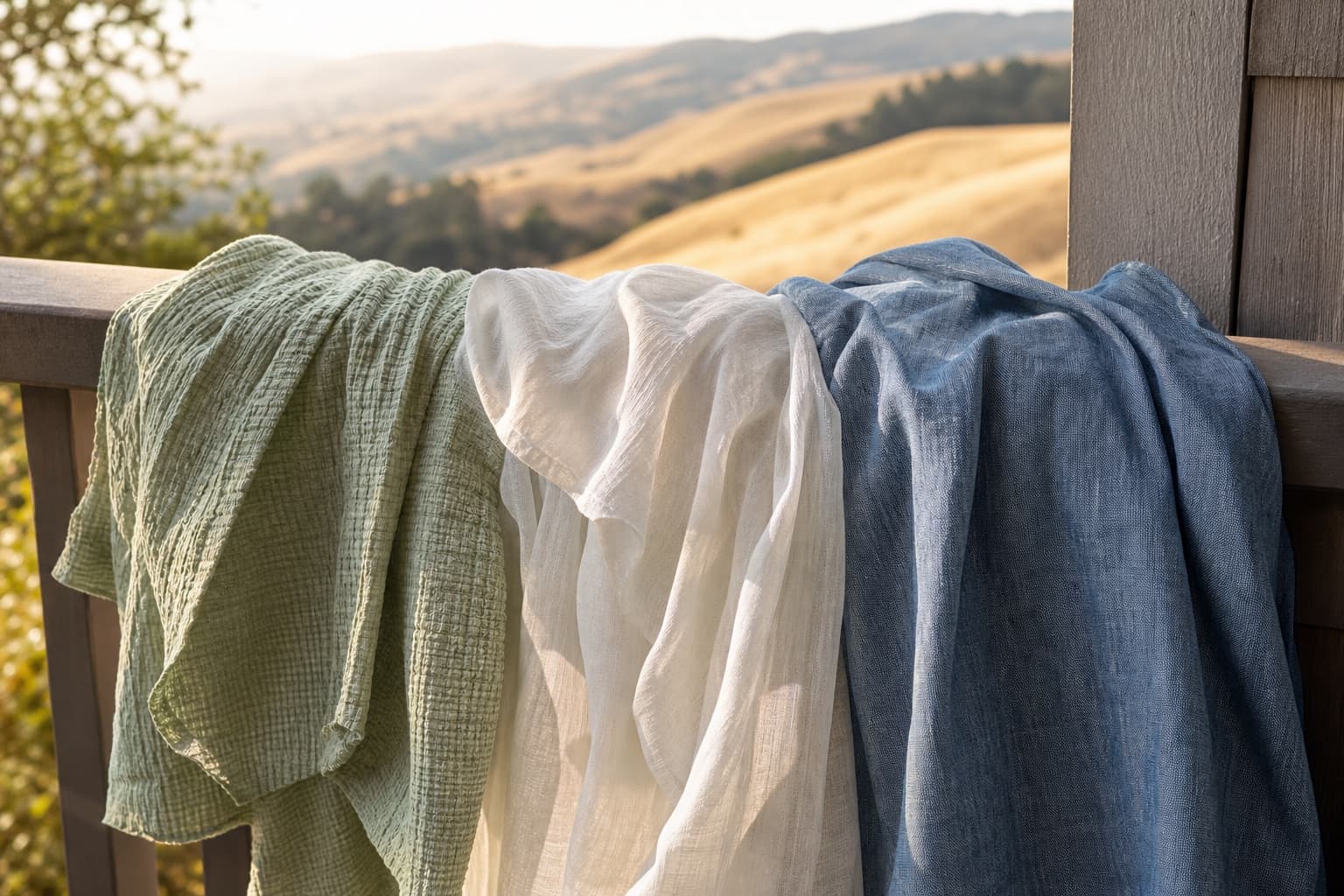
Boise summer is a very specific kind of hot. From late June through early September the Treasure Valley bakes under a high-desert sun, afternoons regularly push past the mid-nineties, and the humidity is so low that shade actually works. It is the kind of heat where a river float sounds like a medical necessity and the Greenbelt empties out between noon and five. The good news for anyone who sews or shops by fiber content: dry heat is the easiest heat to dress for, because evaporation — the body's own cooling system — actually gets to do its job. The right fabric simply has to stay out of the way.
Staying out of the way means three things in this climate. Air has to move through the cloth, so open weaves and fine, lightweight yarns beat dense ones. The fiber should release moisture quickly rather than clinging to it, which is why breathable naturals dominate this list. And because the Boise sun is relentless and the glare off a pale sidewalk is real, a summer fabric has to manage the opacity problem — light enough to breathe, substantial enough that it is not a slip-required situation at the farmers market.
So the picks below are judged on airflow, dry-heat comfort, opacity, and easy care — because nobody wants to iron in July. One more Boise-specific note: the valley cools off dramatically after sunset, so the best summer fabrics here also need to play well under an evening layer. All ten of these do.
Lightweight Linen
Best for: Shirts, wide-leg pants, and dresses for the hottest weeks of the year
In a dry climate, linen is not just the best summer fabric — it is practically a mechanical cooling device. Flax fiber conducts heat away from the skin, absorbs moisture readily, and releases it fast, and in Boise air that moisture is gone almost before you notice it. A handkerchief-weight or shirt-weight linen shirt on a 98-degree afternoon is the closest clothing gets to shade.
- ✓Flax conducts heat away from the body better than cotton, so the fabric itself feels cool to the touch
- ✓Absorbs and releases moisture rapidly — a perfect match for low-humidity heat where evaporation is fast
- ✓Slightly irregular yarns create a naturally open weave that lets air move even in a plain weave
- ✓Gets softer and better with every wash, and the relaxed rumple reads as intentional rather than neglected
Worth knowing: Linen wrinkles enthusiastically and creases hard at elbows and hips — if crisp is non-negotiable, plan on touch-up pressing or choose a linen-cotton blend.
Cotton Voile and Lawn
Best for: Floaty dresses, blouses, and summer sleepwear
Voile and its slightly crisper cousin lawn are the featherweights of the cotton world — fine, high-twist yarns woven light enough to read a shadow through. Voile is floaty and semi-sheer; lawn is smoother and a touch more opaque. Both move air the way a screen door does, which is exactly what an August afternoon in the valley demands.
- ✓Among the lightest wearable cottons made, often well under 100 grams per square meter
- ✓Fine yarns and an airy weave give genuine, measurable airflow rather than just a light feeling
- ✓Takes delicate prints beautifully, so summer dresses and blouses do not have to look utilitarian
- ✓Machine washes easily and dries in minutes on a line in dry Idaho air
Worth knowing: Sheerness is the trade-off — pale voile usually needs a lining, a double layer, or a strategic print to pass the sunlight test.
Seersucker
Best for: Casual shirts, shorts, and warm-weather suiting that skips the iron
Seersucker solves the hot-weather problem with geometry. Its signature puckered stripes are woven in, not pressed in, and they hold the fabric off the skin so air can circulate underneath. That built-in standoff is worth several degrees of comfort, and the crinkle means the fabric never needs an iron — a strong argument in a town where summer evenings are for the porch, not the ironing board.
- ✓Puckered texture lifts the cloth off the skin, creating an air gap that flat fabrics cannot match
- ✓The crinkle is permanent and woven-in, so wrinkles are invisible and ironing is genuinely unnecessary
- ✓Classic cotton versions breathe well and wash without drama
- ✓Light color-and-white stripes reflect sun instead of soaking it up
Worth knowing: The puckered texture is a committed look — it reads casual-classic, and smoothing it flat defeats the entire point of the fabric.
Chambray
Best for: Everyday shirts, casual dresses, and a lightweight sun layer
Chambray delivers the look of denim at a fraction of the weight — a plain weave with a colored warp and white weft that gives that familiar heathered blue. It is the workhorse of this list: opaque enough for anything, soft enough for all-day wear, and light enough that a chambray shirt over a tank is a legitimate sun layer on the Greenbelt.
- ✓Plain weave in shirting weights breathes far better than twill-woven denim of similar appearance
- ✓Fully opaque even in light weights, which makes it the easy answer to the sheerness problem
- ✓Soft from the start and nearly indestructible in the wash
- ✓The mottled two-tone color hides dust, sunscreen smudges, and trail grime gracefully
Worth knowing: Darker indigo-style chambray absorbs more sun than pale fabrics, so in direct afternoon light a light-wash version is the cooler choice.
Rayon Challis
Best for: Flowy dresses, skirts, and wide-leg summer pants
Challis is the drapiest fabric on this list — a soft, fluid plain weave usually made of rayon, which absorbs moisture even more readily than cotton. It swishes rather than clings, falls away from the body so air can move, and feels cool against the skin on the hottest days. For summer dresses and wide-leg pants with movement, nothing on this list flows like it.
- ✓Rayon fiber is highly absorbent and releases heat and moisture quickly in dry air
- ✓Exceptional drape keeps the fabric falling away from the skin instead of sticking to it
- ✓Smooth, cool hand that feels closer to silk than its easy-care reputation suggests
- ✓Carries saturated prints and rich color beautifully for a fabric this light
Worth knowing: Rayon weakens when wet and can shrink or distort in a hot dryer, so wash it gently and line dry — which, in Boise summer, takes about twenty minutes anyway.
Madras
Best for: Camp shirts, shorts, and river-day casual wear
True madras is a lightweight, loosely woven cotton plaid with a soft, almost gauzy hand — a fabric that was engineered for tropical heat and happens to be perfect for a high-desert July. The slightly slubbed, open weave moves air freely, and the sun-faded plaids look right at home between a cooler of drinks and a camp chair.
- ✓Loose, low-density weave lets air pass through more freely than standard shirting
- ✓Yarn-dyed plaids keep their character as they fade, so sun exposure improves the look
- ✓Very light weight for a fully opaque woven cotton
- ✓Softens quickly and machine washes without special handling
Worth knowing: The loose weave that makes madras breathe also makes it less durable at stress points, so it is a shirt fabric, not a pants fabric.
Eyelet
Best for: Sundresses, blouses, and warm-weather special-occasion wear
Eyelet takes the direct approach to ventilation: actual holes, embroidered and finished so they never fray. The result is a cotton fabric with built-in airflow and a decorative texture that carries a summer dress on its own. It is the rare fabric where the prettier it looks, the better it breathes.
- ✓Embroidered openwork provides literal ventilation no solid weave can match
- ✓The base cloth is typically a light, breathable cotton, so even the solid areas stay cool
- ✓Texture and pattern are built in — no print required for visual interest
- ✓Cotton eyelet machine washes and holds up well season after season
Worth knowing: Those holes work both ways — eyelet generally needs a lining or an underlayer, which claws back a little of the breathability it promises.
Shirting Poplin
Best for: Work shirts and polished summer wear that has to look crisp at 5 p.m.
Lightweight cotton poplin is the crisp, put-together option for hot weather — a fine-ribbed plain weave that stays smooth, opaque, and office-appropriate when the parking lot is radiating heat. It breathes respectably for a tightly woven fabric and shrugs off wrinkles better than most of this list.
- ✓Fine, tightly spun yarns keep the fabric light and smooth without becoming sheer
- ✓Crisp surface holds its shape through a full workday in the heat
- ✓Excellent easy-care behavior — a quick press or steam and it looks sharp
- ✓Full opacity in white and pale colors, which are the coolest choices under direct sun
Worth knowing: Its tighter weave moves less air than voile, madras, or linen, so on triple-digit days poplin is the fabric for air-conditioned destinations, not the trailhead.
Cotton Piqué
Best for: Polos, casual pullovers, and golf-course-to-patio wear
Piqué is the textured cotton best known from polo shirts, and its waffle-like surface is quiet hot-weather engineering: the raised geometric texture holds most of the fabric off the skin and creates tiny channels for air. It is the most breathable way to wear a knit collar to a summer barbecue.
- ✓Dimensional texture reduces skin contact, so sweat evaporates instead of soaking in
- ✓Sturdier and more opaque than flat jersey at a comparable coolness
- ✓Holds its shape and resists clinging even after a hot afternoon
- ✓Machine washes and tumbles dry with essentially zero maintenance
Worth knowing: Piqué is heavier than the wovens at the top of this list, so it earns its keep in the shade and the evening rather than in direct 3 p.m. sun.
Khadi
Best for: Relaxed shirts, kurta-style tops, and breezy summer layers
Khadi — handspun, handwoven cotton from the Indian subcontinent — is the artisan wildcard of this ranking. The slight irregularity of hand-spun yarn leaves micro-gaps throughout the weave, which makes khadi noticeably airier than machine-made cotton of the same weight. It has a soft, lived-in texture from day one and a slow-made character that suits Boise's farmers-market sensibility.
- ✓Irregular handspun yarns create a naturally porous weave with excellent airflow
- ✓Highly absorbent cotton that stays comfortable through big temperature swings
- ✓Distinct texture and subtle slubs give plain garments real character without prints or dyes
- ✓Typically low-impact production for those who weigh sustainability alongside comfort
Worth knowing: Handwoven cloth varies from length to length in weight and opacity, so it rewards buyers who can see and touch the fabric before committing.
How to Choose
Weight and Weave: What the Numbers Mean
Fabric weight is usually given in grams per square meter (GSM), and for Boise summers the sweet spot for tops and dresses is roughly 70 to 150 GSM — voile and lawn sit at the bottom of that range, shirting linen and chambray near the top. But weight is only half the story; the weave matters as much. An open, low-density weave like madras or handloom khadi moves more air than a tighter weave of the same weight, while a fine tight weave like poplin trades some airflow for opacity and crispness. When shopping in person, hold the fabric up to a light source: the more pinpoints of light you see through it, the more air will pass through it on your body.
Why Dry Heat Rewards Natural Fibers
Boise's low humidity changes the physics of staying cool. Sweat evaporates almost instantly here, and evaporation is what actually cools you — so the ideal fabric absorbs moisture from the skin and hands it off to the air quickly. Linen, cotton, and rayon all do this well, which is why they fill this list. Standard polyester does the opposite: it holds moisture at the surface and traps heat against the skin, which is tolerable in a humid climate where nothing dries anyway, but a real penalty in the high desert where a natural fiber would have dried ten minutes ago. The exception is purpose-built wicking activewear, which has its place on a trail run but rarely beats linen on a patio.
Solving the Opacity Problem
The lighter and airier the fabric, the more likely it is to be see-through, and the Boise sun is an unforgiving backlight. There are four honest fixes. Choose naturally opaque light fabrics like chambray, madras, or poplin when coverage matters most. Use prints and mid-tone colors, which disguise sheerness far better than pale solids. Line or underlay the sheerest fabrics — a voile dress over a cotton slip is still cooler than a heavier single layer. Or embrace double construction: two layers of gauzy cotton trap almost no heat but add real coverage. Step into direct light in front of a mirror before you commit; the fitting room's soft lighting will lie to you.
Care in a Hard-Water, High-Sun Town
Every fabric on this list machine washes, but summer in the Treasure Valley adds two wrinkles. First, the intense sun that dries a line of laundry in half an hour will also fade saturated colors over a season — dry brights inside out or in the shade of a patio cover. Second, wash in cool or warm water rather than hot: heat sets sweat and sunscreen stains and accelerates shrinkage in loosely woven cottons like madras and khadi. Rayon challis deserves the gentlest treatment of the group — cool wash, no hot dryer, and it will keep its drape for years. Linen's only real demand is that you make peace with its wrinkles.
Frequently Asked Questions
What about cotton double gauze — why is it not in the top ten?
Double gauze absolutely belongs in a Boise summer wardrobe — two whisper-light layers of crinkled cotton tacked together, airy and softly opaque at once. It was edged out only because its niche overlaps heavily with voile and seersucker, which each do one of its jobs slightly better. If you love its cloud-like texture, sew with it or wear it with confidence; just prewash it, because it shrinks more than almost any other cotton.
Are these fabrics warm enough for Boise evenings?
On their own, no — and that is by design. The valley routinely drops twenty-five degrees or more after sunset, so the high-desert strategy is a breathable base plus a removable layer. A chambray shirt, a khadi overshirt, or a linen blazer over any of the lighter fabrics on this list covers the swing from a 98-degree afternoon to a 65-degree concert on the river.
Is linen or cotton better for dry heat?
Linen has the edge in pure cooling: it conducts heat away from the skin faster and moves moisture more aggressively, which is why it tops this ranking. Cotton counters with versatility — more weaves, more prices, easier care, and fewer wrinkles. A practical wardrobe here uses both: linen for the hottest, most casual days, and fine cottons like voile, lawn, and chambray for everything that needs a bit more polish or coverage.
Do dark colors really matter as much as fabric choice?
In direct sun, yes — a dark fabric can feel dramatically hotter than the same cloth in white or a pale tone, because it absorbs rather than reflects solar radiation. Fabric choice still matters more overall, since a black linen shirt will outperform a white polyester one once you start sweating. The winning combination for a Boise afternoon is light color plus breathable fiber; save the darks for evening.
How should I test a fabric for breathability before buying?
Three quick checks work in any fabric store or fitting room. Hold the cloth to the light: visible pinpoints through the weave mean air can move. Press it to your lips or inner wrist and exhale — you should feel your breath pass through easily. And crumple a handful for a few seconds: naturals like linen and cotton spring back with soft creases, while a fabric that feels clammy or springs back perfectly slick is likely a tightly finished synthetic that will wear hot.